


Process Control
Hydraulic Actuator Comparison
In the process industry, hydraulic actuators are used primarily for applications where high force, high stiffness or high speeds are required. Applications with these criteria can now be accomplished with an all electric solution from Exlar.
Hydraulic cylinders, while robust and reliable, rely on pressurized oil and require significant maintenance to achieve consistent levels of positioning accuracy. While this oil is not compressible, it is susceptible to temperature swings, impacting repeatability and performance. Fluid leaks are common, causing environmental contamination. In addition, hydraulics have high sensitivity to oil contamination and oil quality, therefore filters need to be installed to keep the oil clean.
New options for hydraulics are now available that are self contained closed systems that do not require filters of oil clearing. These hydraulic actuators however, are sill susceptible to temperature changes and leaks. Maintenance can still be high, as each have several complicated parts including internal pumps, valves, heaters and motors, in addition to a separate controller.

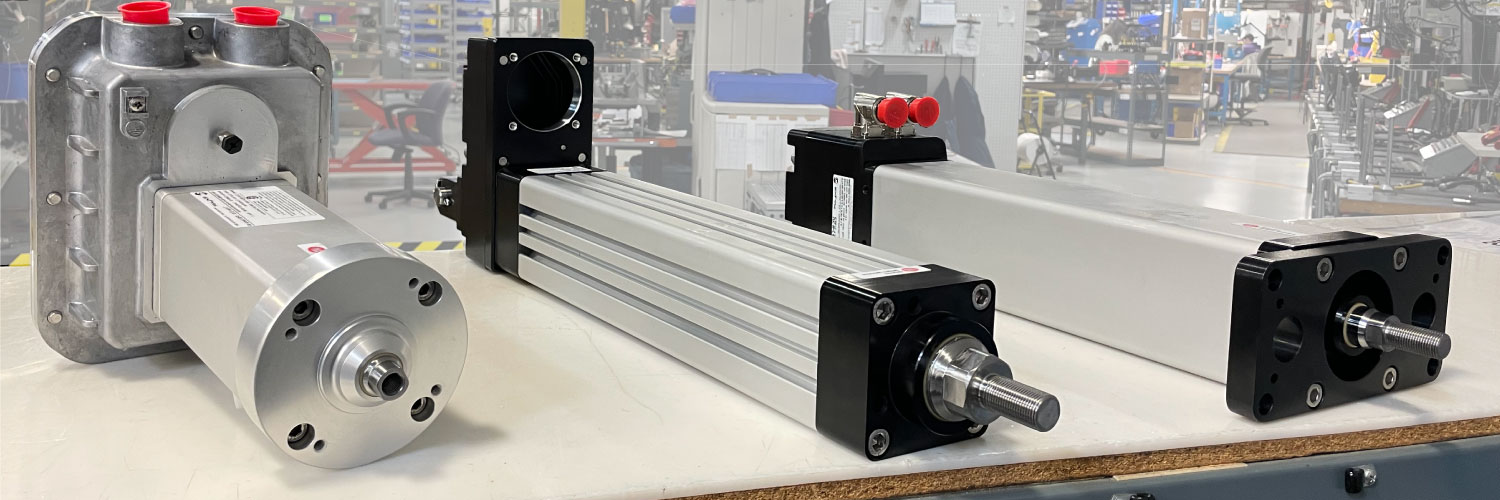
Exlar actuators were designed with hydraulic replacement in mind. They several advantages over hydraulic such as higher energy efficiency, higher uptime from lower maintenance, repeatable performance, much smaller footprint and a less-costly infrastructure. Common applications include inlet guide vanes, steam turbine governor valves, bypass valves and spray valves for the power industry as well as pipelines and isolation valves for the oil and gas industry.
Forces are available up to 50,000 lbs continuous.
|
|
Exlar |
Hydraulic |
|---|---|---|
|
Load ratings |
Very High |
Very High |
|
Lifetime |
Very long |
Can be long |
|
Acceleration |
Very high |
Very high |
|
Electronic Positioning |
Easy |
Difficult |
|
Stiffness |
Very high |
Very high |
|
Relative Space Requirements |
Minimum |
High |
|
Efficiency |
>90% |
<50% |
|
|
|
|
|
Maintenance |
Very low |
Very high |